Showing posts with label piedmont velo sports. Show all posts

Saturday, May 5, 2012

Brooks B18 LADY

Brooks B18 LADY
Brooks is proud to offer the B18 Lady, featuring the original embossed flowers design of 1905. In 1898 John Boultbee Brooks patented a process to emboss leather saddles. By the beginning of the 1900’s Brooks was able to supply a range of richly decorated products for ladies. The B18 Lady is one of the finest examples of these saddles. A true collector’s item, the B18 Lady also features the same unique loop springs - incorporated within the saddles rails - which were among the first suspension features to be patented by their forefathers.

The famous Brooks name plate and saddle bag loops on the rear of the B18 Lady.

Click here to go to the Brooks England web site.

Monday, April 23, 2012

1914 Tour de France

1914 Tour de France Route

The 1914 Tour de France was the 12th Tour de France, taking place from June 28th to July 26th. The race 5,405 kilometers (3,359 miles) was started by 147 riders and the average speed was  26.835 kph (16.67 mph). There were a total of 15 stages. Seven racers that started the Tour were previous Tour de France winners; Philippe Thys, Louis Trousselier, Lucien Petit-Breton, Octave Lapize, Francois Faber, Odile Defraye and Gustave Garrigou. The only notable change to the Tour protocol was the addition of race numbers being attached to the rider's bikes. The cyclists used whistles, to warn people they were coming. (mainly on downhills)
 The 1914 Tour de France Field. 

The day the 1914 Tour de France started, June 28, was the same day that Serbian secret agent Gavrilo Pincip assassinated Austo-Hungary's Archduke Ferdinand. This event started the tragic series of ultimatums between the powers of Europe and brought about the beginning of World War I. The 1914 Tour ended on July 26. On August 3, Germany declared war on France and invaded Belgium. The Tour de France would not be held for the next five years.
You look closely to see the 1914 Tour de France riders in the picture above.


The 2 favorites were the previous years Tour winner Phillipe Thys and his teammate, the talented but volatile Henri Pelissier. Thys was dominant the entire race. Even though his only stage win was the first stage, he finished in the top five in every other stage.
Thys crests the Galibier. Henri Pélissier went over first.

After thirteen stages Pelissier was in second place 31 minutes and 50 seconds behind Thys. In the 14th stage to Dunkerque, Thys' had a mechanical breakdown. Receiving any help while fixing your bicycle was not allowed, and in the 1913 Tour de France, Eugene Christophe lost too much time and ultimately his chances of a victory by repairing his own bicycle. Thys decided to take the risk of a time penalty, and bought a new wheel at a shop. This cost him a 30 minute penalty, which left Thys only 1 minute and 50 seconds ahead of Pelissier. Pelissier did his best to overcome the time difference, but Thys followed him. In the end, Thys stayed less than two minutes ahead of Henri Pelissier, and managed to keep that margin until the finish in Paris.

Final 1914 Tour de France General Classification:

1. Philippe Thys (Peugeot) 200 hours 28 minutes 48 seconds
2. Henri Pelissier (Peugeot) @ 1 minute 50 seconds
3. Jean Alavoine (Peugeot) @ 36 minutes 53 seconds
4. Jean Rossius (Alcyon) @ 1 hour 57 minutes 5 seconds
5. Gustave Garrigou (Peugeot) @ 3 hours 21 seconds

Peugeot took 4 of the top 5 places.

Phillipe Thys; winner of the 1914 Tour de France
Click here to learn more about Phillipe Thys.

Henri Pelissier; finished second in the 1914 Tour de France.
Click here to learn more about Henri Pelissier.

Jean Alavoine; finished third in the 1914 Tour de France.
Click here to learn more about Jean Alavoine.

Jean Rossius; finished fourth in the 1914 Tour de France.
Click here to learn more about Jean Rossius.

Gustave Garrigou; finished fifth in the 1914 Tour de France.
Click here to learn more about Gustave Garrigou.

Wednesday, April 18, 2012

Henri Pelissier

Henri Pelissier (1889 - 1935) was a French racing cyclist from Paris and champion of the 1923 Tour de France.


Pelissier was one of four brothers, three of whom became professional cyclists. He began racing professionally in 1911 and amassed important victories before the First World War, including the 1912 Milan-San Remo and three stages in the 1914 Tour de France.
Pélissier brothers (l to r) Henri, Charles, Francis

One day in August of 1911 while walking on the edge of Paris Henri Pelissier met Lucien Petit-Breton, one of the great cycling hereos of the day. Petit-Breton had already ridden the Tour de France four times and won it in 1907 and 1908. He asked Pelissier if he would like to travel to Italy with him to race. Six hours later they were on a train to Milan.


Their first race was the Tour of Romany-Tuscany. Pelissier crashed and didn't finish. But he won Turin-Florence-Rome and the Tour of Lombardy. 


 In his first time racing the Tour de France, Pelissier finished second in 1914 less than two minutes behind Philippe Thys of Belgium. He won the 10th, 12th and 15th stages.


 In 1923 Henri Pelissier  won the Tour de France at the age of 34. During his career he also won Milan - San Remo, Paris - Brussels, Paris - Roubaix twice, Tours of Lombardy three times, Bordeaux - Paris and Paris Tours.


Pelissier was repeatedly at war with organisers, sponsors and the press. When  he went training, he urged his friends to take it easy - "it's important not to wear yourself out" he advised - but never letting on that he had been out at dawn for 40 kilometres of "speed training".


He dismissed his rivals with a sneer. "The others are cart horses; I'm a thoroughbred," he said during the Tour de France. The next day Pelissier had a flat tire and the whole field left him and his brother Francis 30 minutes behind. 
Pelissier rode his last Tour de France in 1925. He did not finish. He stopped racing in 1927 and did nothing for two years. Then he returned to the sport as a motorcycle-pacer and team manager. He had little success at either. 


Henri Pelissier's first wife, Leonie, despaired and shot herself in 1933.  A few years later Pelissier had a girl friend, Camille Tharault, who was 20 years younger than him. He threatened her with a knife at least once. On May 1, 1935 he and Camille had an argument in the kitchen of their Norman-style villa outside of Paris. Pelissier lunged at her with a knife, cutting her face. She ran to the bedroom, opened a drawer and pulled out the revolver with which Leonie had shot herself. She ran back to the kitchen and found Pelissier waiting with the knife. Camille pulled the trigger five times. Pelissier fell to the floor. A bullet had hit his carotid artery. His body was placed in the room where Leonie had killed herself. 


Camille's trial opened a year later, almost to the day. She pleaded self-defence and on May 26, 1936, she got a year's suspended jail sentence. It was as close as the court could come to acquitting her.

Wednesday, April 11, 2012

Albert Champion

Albert Champion

Albert Champion (1878-1927) was a French bicycle racer. In 1908 he founded the Champion Ignition Company to make spark plugs in Flint, Michigan. In 1909 the name changed to AC Spark Plug Company, after his initials.

Champion won the third edition of Paris-Roubaix in 1899. His win came as a surprise because he was known as a talented track racer. The 1899 Paris-Roubaix was paced by small motorcycles.  Track racers were accustomed to this and it worked in Champion's favor. After his win he traveled to the United States to earn money racing on the velodromes. (track racing at this time was more profitable than professional baseball) He raced behind motorcycles and earned a comfortable living. Champion earned enough money to be able to afford a race car. 

In the United States Champion was involved in a crash that left one of his legs two centimetres shorter than the other. He accommodated this on the bike by using crank arms of different lengths. He returned to France and won a 50km race on the Buffalo track in Paris and in 1904 became the national motor-paced champion. The race reopened the wound to his leg and he was taken to the hospital in Boucicant. While in the hospital he saw another fellow rider brought in with injuries from a crash at 90 km/h (approximately 56 mph). Seeing this ended Albert Champion's bicycle racing career.

Saturday, April 7, 2012

Raymond Impanis


Raymond Impanis

Raymond Impanis (1925 –  2010) was a Belgian professional cyclist from 1947 to 1963. 

He was born in the Flemish Brabant town of Berg. Where his family owned a bakery. During World War II there was no gasoline to fuel their delivery truck. Each morning teenaged Raymond would get up and make bread deliveries on his bike. After his deliveries were done he would haul over 200 pounds of flour from the supplier to his family's bakery on a three wheeled delivery bike. He bought his first racing bike with the tip money he received from the customers.


Impanis started racing in the junior races in 1942. In one of his early races he had a very bad crash, slamming into an electric pole during a sprint. As a result of the crash his right arm was almost completely paralyzed. For the rest of his life he could barely lift his right hand. This didn't stop him from racing, he just became a lefty.


Raymond Impanis turned pro in 1947 after racing succesfully as a junior and an amateur. He raced the Tour de France his first year, winning a stage and finishing 6th overall. After such a great debut Impanis became Belgium's great Tour de France hope. He never won the Tour, but won a total of three stages and finished in the top ten in 1949 and 1950. 
Impanis had a long career of 17 years as a professional: 1947 -1963. He is most famous for his 1954 season where he won the Tour of Flanders, Paris-Roubaix and Paris-Nice. At the end of his long road career, Raymond had hoped to cash in for big pay days on the winter six-day indoor track circuit. Only one problem though...you can't do a hand-sling very well in the jams when your right arm is nearly paralyzed. He started motopaced racing on the track to extend his paydays and popularity a little longer.

Raymond Impanis motorpaced racing on the track.

After retiring Impanis worked for race radio and was a fixture at Belgian races. He never really stopped riding, still cruising around on a lightweight bicycle with flat bars well into his eighties.

Saturday, March 24, 2012

Inga Thompson


Inga Thompson

Inga Thompson is a  former road bicycle racing professional from Reno, Nevada. She started professional cycling at 20, in 1984. That year she rode the 1984 Los Angeles Olympics road race and finished 21st. Her career ran from 1984 to 1993. She competed in two more Olympics(1988,1992), won national championships (1987,1988,1991,1993), and finished second in two world championships (1990,1991).


She was recognizable by her long braid which she clipped to her uniform.
Inga Thompson 1990

Olympics 1992

Monday, March 19, 2012

A perfect day for a ride!

Today I got out with a couple of my friends, Jake and Tim, to go for a ride. This morning was foggy and overcast, but by lunch time the clouds cleared away and the temperature climbed into the 70s. Our plan was for all three of us to do a 20 minute field test to dial in our power zones for training. Riding on Shallowford Road before and after our field tests was fun. The field test was painful as it always is, but beneficial for all of us. 
Field Testing on Shallowford Road. 

You can see tree's and other plants blooming along the road in the video above. Just a beautiful day for riding a bike or being outside. Hope everyone got out and enjoyed the day.  
I rode past this pasture with Ponies, Lamas and a Donkey on the way home. 
 Once I was home Poor Ole' Joe kept me company as I cleaned my bike. 

Friday, March 16, 2012

Joseph Fischer

Joseph Fischer
 Josef Fischer (1865 - 1953) was a German road bicycle racer. He is best known for winning the first edition of Paris–Roubaix in 1896 and Bordeaux–Paris in 1900.
Joseph Fischer 

Thursday, March 15, 2012

Back to Wensday Night Rides from CG Hill Memorial Park

The video below is some of the scenery on Seward Rd, part of "Julie's Loop". Temperatures were in the low 80s at the beginning of the ride. What a great evening to ride a bike!
Music: Jump Little Children by Leroy Dallas

Wednesday, March 14, 2012

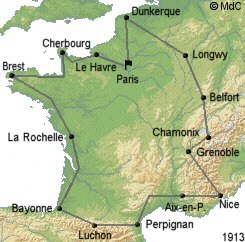
The 1913 Tour de France

Route of the 1913 Tour de France
The 1913 Tour de France was the 11th Tour de France. Total distance of the race was 5,388 kilometres (3,348 miles) covered at an average speed of 26.72 kph (16.60 mph) by the racers. For the first time the route of the race was run in a counterclockwise direction. The first African cyclist took part in the Tour de France in 1913: Ali Neffati from Tunisia. In all there were 140 riders that started the Tour that year.
The sprint finish at the end of stage 4 in La Rochelle, won by Marcel Buysse.


Between 1904 and 1912, the overall classification had been calculated by points, but in 1913 the classification was reverted to the original format from 1903, where the overall classification was calculated by adding up the times of the individual stages. 


Calculating the winner of the tour on a points-based system instead of elapsed time created rather flat racing. Since a gap of 1 second had the same effect on the overall lead as a deficit of 3 hours, riders could let a break get a big lead without worrying about its having a serious effect on the standings. 


The other reason was a because of Desgrange's, the tour organizer, stern rules regarding bicycle repairs. A rider had to fix his own bike without assistance. If a rider had to spend the better part of an hour performing a repair it would be devastating to his standings in a time-based system. in a points based system, it might mean the loss of only a few places in a single stage.
The riders finish stage 5 in Bayonne.
Alcyon's Odile Defraye, winner of the 1912 Tour de France, was never out of the top 7 places and usually in the top 3 in the first 5 stages. That put him in the lead after stage 5 with Eugene Christophe second. Phillpe Thys, Christophe's Peugeot teammate, was sitting in fifth place. 85 riders had already abandoned the Tour. 


After stage 5, the standings were:


1. Odile Defraye
2. Eugene Christophe @ 4 minutes, 55 seconds
3. Marcel Buysse @ 10 minutes, 5 seconds


Thys, Christophe, Buysse and Garrigou suffer on the rough roads of the time, during Pyreneen Stage.


Firmin Lambot, winner of the 1919 and 1922 Tour de Frances, crests the Aubisque.

Stage 6 is one of the most famous in Tour de France history. It was 326 kilometers (202.57 miles) from Bayonne to Luchon and took the winner 14 hours to complete. It also cross (in order) the mountain passes of the Aubisque, Tourmalet, Aspin and Peyresourde. At the start of stage 6, last year's winner Odile Defraye lead the general classification, some 5 minutes ahead of Eugene Christophe. When the first mountains were climbed, Defraye was dropped quickly, and Christophe lead the race. Christophe came up first on the Aubisque, and in second place behind Phipippe Thys on the Tourmalet.


 The fork on Christophe's bike broke on the way down the Tourmalet. His bicycle was completely unusable, and the rules said that he had to repair it himself. He shouldered his bike and carried his broken fork and front wheel in his other hand. Accounts differ on the distance that he had to walk/run to get to the next village. According to L' Auto, the newspaper that sponsored the Tour de France, he had to walk/run 14 kilometers (8.70 miles). Christophe's account of the distance puts it at 10 kilometers (6.21 miles). When he reached the village a young girl took him to the blacksmith's shop. 


In those days, remember, there where no follow cars with bikes ready at a moment's notice to be handed to a racer with a mechanical problem. These were the days in which a racer had to perform his own repairs on his bike.


Christophe was not only a good bicycle mechanic, he had been  a locksmith and had metalworking skills. The blacksmith gave Christophe some verbal guidance. Under the rules, that was all that could be allowed. He worked on it for four hours, being watched by race officials, who made sure that he was not helped by anyone. When Christophe asked a small boy to work the bellows, he was penalised 10 minutes. After his bicycle was fixed, he rode away and finished the stage, 3 hours and 50 minutes later than the stage winner Thys. Christophe's chances to win the 1913 Tour de France were over. 
Chasing Buysse on the Galiber are Francois Faber (left) and Gustave Garrigou.

After the sixth stage, Marcel Buysse was in the lead. In the ninth stage, Buysse had a broken handlebar, and finished almost three and a half hours after stage winner Lambot. This was the end of the chances for Buysse for the victory. Buysse did not give up, and won four of the remaining five stages.
Marcel Buysse was first over the Galibier and went on to win stage 11.


The lead had transferred to Thys now.  In the last stages, the race focussed on the duel between Petit-Breton and Thys. In the 14th stage, Petit-Brton fell down and stopped the race. In the same stage,  Thys also fell down and remained unconscious for a while. When he was conscious again, he was helped to repair his bicycle. All help was illegal in 1913, but the jury only gave him a 10 minute penalty. Thys finished the stage, and kept 8min. 37 seconds in front of Gustave Garrigou in the general classification. In the final stage, Thys stayed with Garrigou, and so won the 1913 Tour de France.

Final 1913 Tour de France General Classification:
1. Philippe Thys (Peugeot) 197 hours 54 minutes
2. Gustave Garrigou (Peugeot) @ 8 minutes 37 seconds
3. Marcel Buysse (Peugeot) @ 3 hours 30 minutes 55 seconds
4. Firmin Lambot (Griffon) @ 4 hours 12 minutes 45 seconds
5. François Faber (Peugeot) @ 6 hours 26 minutes 4 seconds
6. Alfons Spiessens (JB Louvet) @ 7 hours 57 minutes 52 seconds
7. Eugène Christophe (Peugeot) @ 14 hours 6 minutes 35 seconds
Peugeot took 5 of the top 7 places and won 10 of the 15 stages. 25 riders finished.


Philippe Thys, winner of the 1913 Tour de France
Click here to learn more about Philippe Thys

Gustave Garrigou, 2nd place in the 1913 Tour de France
Click here to learn more about Gustave Garrigou.

Marcel Buysse, 3rd place in the 1913 Tour de France.
Click here to learn more about Marcel Buysse.

Firmin Lambot, 4th place in the 1913 Tour de France.
Click here to learn more about Firmin Lambot.

Francois Faber, 5th place in the 1913 Tour de France.
Click here to learn more about Francois Faber.

Tuesday, March 13, 2012

Gilbert Bauvin

Gilbert Bauvin (born August 4, 1927) is a former professional French road bicycle racer. He was a professional from 1950 to 1960. The highlights of his career include winning the Paris–Camembert in 1954 and Tour de Romandie in 1958 and winning four stages in the Tour de France as well as wearing the yellow jersey for a total of four days. His best grand tour result was the 1956 Tour de France, where he finished second.

Gilbert Bauvin  during the 1956 Tour de France

Monday, March 12, 2012

Back To Zone 4 Intervals

Click on the photos to enlarge them.
Tim and Jake back at the Lewisville Town Square.

I met Tim and Jake this afternoon at the Lewisville Square. We talked about the workout we planned to do that day as we warmed up. Hauser Road is a short distance from The Square and has a smooth surface with little traffic. We all did our own interval work outs. The combined time of the working intervals and the recovery intervals was about an hour and a half. After that we got in a nice 30 minutes of easy spinning. The temperature was in the 60s and overcast with a light breeze. This all combined to make a good day for riding. By the time I rode back home I had in a ride time of approximately 3 and a half hours. Since Day Light Saving Time is now in effect, I had time to eat supper and play some fetch with Poor Ole' Joe.
Poor Ole' Joe was glad to see me when I arrived home.

Mark Webb - The Webbie Show - TotalBMX

Sunday, March 11, 2012

A Nice Sunday Afternoon To Go For A Bike Ride

Click on the photos to enlarge them.
Kelly Holmes

Temperatures were in the 60s this afternoon in the Winston-Salem, NC area. I headed out from my house around 1:30 on my bike headed to the Town Square in Lewisville, NC. While riding on Harper Road, out in the country, I sensed someone coming up on me from behind. I looked back and was glad to see my friend Kelly Holmes gaining on me quickly. Kelly and I have been riding together off and on for over twenty years now. We often see each other on the road unplanned and go for a nice ride. 
The Cat 8 group assembling before the ride

At the square we saw several members of the Cat 8 group assembling before the ride. This is a great group of riders that ride from the Lewisville Square on Saturday and Sunday. I'm not able to join in with them on Saturday's because I am working. On Sundays they ride at 2:00 in the afternoon this time of year. They were planning on riding a loop called "Liberty Church". A planned distance of approximately 40 miles. Kelly and I joined in and rode at the back chatting. The group rode in a single file paceline for a couple of miles until we were out of town. Once we were out in the country and not an impediment to traffic we switched to a double paceline. There were lots of long fairly straight stretches on the route we rode today. We rode smooth and steady. Once back to the square Mark Speas checked his Garmin and reported an average speed for the ride of 19.4 miles per hour. That's a good pace, but didn't seem too hard since we just kept rolling the whole time. This was a good group ride. After riding to and from the ride I ended up with a total distance of right at 60 miles.
Poor Ole' Joe supervised me wiping down my bike once I returned home.

Peter Winnen

Peter Winnen 1981


Peter Johannes Gertrudis Winnen (born September 5, 1957) is a Dutch former road racing cyclist. He was professional from 1980 until 1991. Among his 14 victories were two stages at Alpe d'Huez in the Tour de France and a national championship. He finished third in the Tour de France in 1983.

Thursday, March 8, 2012

17th PARIS BREST PARIS - RANDONNEUR 2011 // BROOKS ENGLAND

Fit Kit Training

Click on the photo to enlarge it.
A great group of bicycle industry professionals.
I just got in from a Fit Kit Training Seminar in the Baltimore/Washington DC area. Chris, from Fit Kit, did  a great job teaching the class and really knows his stuff. I like to attend at least one fit training program a year to stay sharp on my bike fitting methods. Each time I pick up a couple of new techniques from the class and also from the other bike fitters. It's sad to leave the class and the new friends that were made during the few days we worked together. I wish them all well and hope our paths will cross again soon!