Friday, January 29, 2016

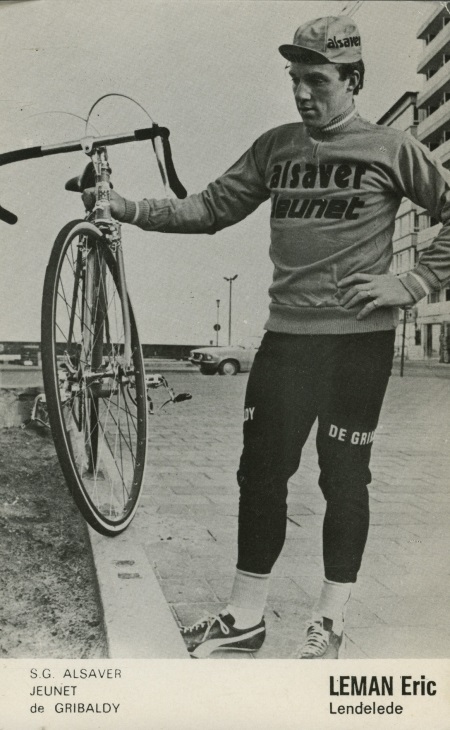
Eric Leman

Eric Leman 1973
Eric Leman (born July 17, 1946) is a retired Belgian cyclist from West Flanders. He raced as a professional for ten years beginning in 1968 through 1977. During his career he is credited with 77 victories. He is most famous for his three wins at the Tour of Flanders: 1970, 1972, 1973. Leman won five stages of the Tour de France during his years of racing.


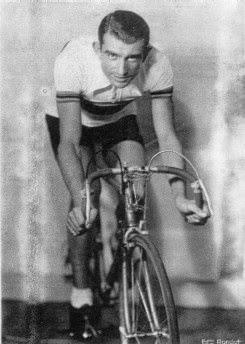
Eric Leman 1975

Thursday, January 28, 2016

Gunnar Roadie - Project Bike - Three Year Review

Gunnar Roadie
It's been well over three years since I first built up my Gunnar Roadie and began riding it. Together we have been on many wonderful adventures. I have had many great bikes, but this is the one I think of when I am going out for a ride. The geometry of this 52 centimeter frame fits me perfectly. 

Over the years all the parts on my Roadie have changed. It now has a Shimano 6800 11-speed group, Thomson seatpost and stem, an FSA carbon fiber handlebar and a 28 spoke wheelset. The weight of the bike as it is seen in the picture with everything on it (rear light, computer, seabag, etc.), minus the water bottle, is just over 19 pounds.

 I built the wheels out of new parts I have had for awhile and have never used. The rear hub is a Powertap SL and the front hub is a Paul's Components high flange. The rims are Velocity A23s with Continental 4000s tires. This combination makes for a great riding and reliable wheelset. 

Powertap SL Hub

Paul High Flange Front Hub
The very features that many bicycles are sold by, are the very ones that make this bike work so well. External brake and derailleur cables improve the performance to a level that no internally cable routed bike will ever be able to match. 

I recommend a Gunnar Roadie to anyone looking for a bicycle that they can ride and enjoy for many years.  I look forward to many more great cycling adventures riding this bicycle.
Poor Ole' Joe and my Gunnar Roadie


Wednesday, January 27, 2016

A fixed gear bike with fenders is a good choice for riding on a day like today!

Fixed gear bike with fenders

Last weeks snow is finally melting off of the roads. This is the second day in a row with temperatures in the upper 40s to mid 50 degrees. The snow is mostly melted off of the roads, but there are several inches on the sides of the road. The melting snow is making the roads mostly wet.

On a day like today, I enjoy riding my fixed gear bike that has fenders on it. Riding fixed is an efficient way to get in a workout without pushing the speeds. The continuous pedaling required of a fixed bicycle also keeps you warmer in cold wet weather.

Whenever I ride a fixed gear bike in January  it brings back memories of bicycle rides back in the late 1980s and early 1990s. In those years most cyclists owned at least one steel framed bike that had horizontal dropouts in the rear. This type of dropout enables you to slide the wheel back to create proper chain tension for running a single cog. It was traditional with many riders to use a fixed gear bike for the first thousand miles of the calendar year. I've been on many group rides where we were all riding fixed.

A saddle cover is a good idea to protect leather saddles on a wet day. My "Path Racer" has a nice Brooks B17 saddle that I find comfortable. I want to take care of this saddle so I can enjoy it for many years to come.
Borrow a friends bike, if possible, to try riding a fixed gear bike. Just be aware that you may become addicted!

The Stars and The Water Carriers: The 1973 Giro d'Italia

Sunday, January 24, 2016

The Cycling Anthology: Volume One - Book Review

The Cycling Anthology Volume One
The Cycling Anthology: Volume One
Edited by Ellis Bacon & Lionel Birnie
Paperback - 272 pages

First Published in Great Britain in 2012 by Peloton Publishing

Yellow Jersey Press
Random House
 20 Vauxhall Bridge Road
London SW1V 2SA


Printed in Great Britain by Clays Ltd, St Ives plc


The Cycling Anthology: Volume one is a nice book that covers many different bicycle racing subjects and history. The book is written by sixteen different writers from magazines, newspapers and books. All the contributors are english speaking and from the USA, UK and Australia. 

Each chapter is an original writing and unique to this book. Not a reprint of an earlier published articles or interviews. 

The size and structure of this book makes it great for traveling. Many single topics are covered in each section. The Cycling Anthology is great to pick up and read awhile and then come back to it later on.

I recommend this book to anyone interested in bicycle racing. It is an enjoyable read. I look forward to reading the other volumes of The Cycling Anthology!

This book is available many places. I buy most of my books from either the publisher directly or Barnes and Nobles. Barnes and Nobles operates a brick and mortar store in my home town. I enjoy browsing in book stores, so I want to support them.


Friday, January 22, 2016

Walter Godefroot

Walter Godefroot at the 1967 Liege-Batogne-Liege
 Walter Godefroot  (born July 2, 1943) is a retired Belgian professional road racer.  His professional racing career lasted for 15 years, beginning in 1965 and going through 1979. Godefroot is credited with 155 professional race victories. He won a bronze medal in the individual road race at the 1964 Summer Olympics, before turning professional.


Godefroot was a specialist in one-day classic cycle races. He won the 1967 Liege-Bastogne-Liege,  1969 Paris-Roubaix, and the Tour of Flanders (1968, 1978). 

 At the Tour de France he had a total of 10 stage wins and won the green jersey in 1970.

Walter won the Belgium National Road Race Championship in 1965 and then again in 1972.

Eddy Merckx said "Walter Godefroot is the only one of my adversaries who I never beat in a direct fight for victory."

After retiring as a rider, he became the director sportif of the T-Mobile professional team. At T-Mobile he guided Bjarne Riis and Jan Ulrich to back-to-back Tour de France victories. 

Walter Godefroot winning stage 9 of the 1971 Tour de France


Walter Godefroot winning in the 1974 Henninger Turn Classic


Monday, January 18, 2016

Frans Bonduel

Frans Bonduel 1931

   Frans Bonduel (1907-1947) was a Belgium professional bicycle racer from 1928 through 1947. 

   He raced for the Dialect-Wolber team all twenty years of his career. Occasionally he would ghost ride for another team at a few races if his real team wasn't going to participate. 

   Bonduel won forty four professional bicycle races. A few of his major victories are: Tour of Flanders 1930,  Paris-Brussels 1934 & 1939,  Paris Tours 1939.

   Frans Bonduel won three stages of the Tour de France. His first stage win came in 1930 when he won the 17th stage. He won stages 6 & 7 during the 1932 Tour de France.


Tuesday, January 12, 2016

Colnago's Bicycle Museum

Rene' Herse, Book Review


Rene' Herse

Written by: Jan Heine

Published by: Bicycle Quarterly Press
2116 Western Avenue
Seattle WA 98121

Copyright: 2012 
Printed in Malaysia
424 pages


Rene' Herse (1908-1976) was a constructor of fine bicycles from 1940 till his death. His bikes were most sought after by Cycletourists during the 1940s and 1950s. Herse's shop was in Paris France. He continued to manufacture and sell complete bikes through the German occupation of France during World War II. 

This fine book contains hundreds of photos of Rene' Herse's bicycles, riders and the shop where the bikes were made. Upon first examination of this book I assumed it to be a picture book with a lot of captions. When I sat down and began to read it, instead of flipping through the pages and looking at the photos, I found it to be very good reading. I enjoyed seeing the bikes and riders, but also hearing about their rides and competitions. A glimpse of life in Paris during the war is exposed while reading this book. 

Much of the information and photos contained in the book came from riders of Rene Herse bicycles. His daughter, Lyli Herse, was instrumental in Jan Heine's 10 years of research while writing this book. Lyle Herse rode and raced very successfully on her fathers bicycles and after his death continued in the production of Rene Herse Bicycles. 

This book sells for $85.00 and is a good investment and addition to any cycling library. It is my option that to truly understand bicycles one must study the history of them.  I highly recommend purchasing this book and taking the time to read and absorb it. Rene' Herse is available to purchase at 

Sunday, November 15, 2015

Tuesday, October 14, 2014

Henri Van Lerberghe

Henri Van Lerberghe


Henri "Ritte" Van Lerberghe (1891 - 1966) was a Belgium racing cyclist who raced as a professional form 1910 through 1923. He is most famous for his win of the 1919 Tour of Flanders. The  third edition of the race. 

His racing style was to attack at the beginning of races. This usually didn't pan out for him, because it left him exhausted at the end of the race and unable to compete for the top places. Van Lerberghe was popular with the spectators, because of his aggressive riding during the early part of races.

"Ritte" won the fifth stage of the 1913 Tour de France.  He was racing in the category of an isolated cyclist. (individual cyclist, not part of a team) The "isolated cyclists" started fifteen minutes after the racers that were  members of a team. He was able to catch up to the lead cyclists and then go on to win the stage.

Henri finished in second place overall at the 1914 Tour of Flanders. Racing in Europe was put on hold for several years at this time because of World War I.

No one considered Henri Van Lerberghe a possible winner of the 1919 Tour of Flanders. World War I had just ended and he traveled from his military assignment straight to the starting line of the race. He showed up without a bicycle. After  borrowing a bike from a local, he announced that he was going to ride all the other racers to death (off of his wheel). His statement amused the other riders and they laughed loudly at him. Van Lerberghe never had many great race results and wasn't thought to be much of a threat to the top racers. His reply to their laughter was that he would 'drop them all at their own front doors on the way to victory'. As soon as the race had begun, in true Ritte fashion, he attacked as hard as he could. 

The other riders didn't chase after the attacking rider for a some time. Pitying him, they wanted to allow him a breif moment of glory. Once they decided to catch up to him, it was too late. 

Henri Van Lerberghe was intent on not being caught and rode in a fury. He came upon a train stopped across a railway crossing. Determined that nothing would stop him, he dismounted his bike and ran through an open train car with his bike across his back. Once through the train he jumped back on his bike and continued his ride. When he saw the velodrome, where the race was going to finish, he knew he had a huge gap on the rest of the field. He decided to stop at a pub outside of the velodrome and have a beer. It tasted so good to him that he ordered and drank several more. He was finally convinced to finish the race. After making his way across the finish line and winning the race, he was so intoxicated that he had to walk his victory lap instead of riding. He then announced to the crowd of spectators "You can all go home! I have a half a days lead on the others!" He actually only had a lead of 14 minutes on the rest of the racers. 14 minutes remains the biggest lead of a break away rider at the finish of the Tour of Flounders to this day. 

Saturday, October 11, 2014

Gunnar Roadie - Project Bike - Two Year Ride Review

Gunnar Roadie on the scales.
Gunnar Roadie


It's been two years since the build up of my Gunnar Roadie Project Bike. Thousands of miles and many component swaps have taken place on the Roadie in this time. 

A quality steel frame and fork, such as the Gunnar Roadie frameset, make for a bike that can be ridden a lifetime. (with reasonable care and baring any major accidents) 

Over the past two years I have changed many components on the bike:

  • Went from Shimano Ultegra 6700 10 speed group to an Ultegra 6800 11 speed group.
  • Swapped out the Pro Vibe 7 handlebars for FSA SL-K carbon handlebar 
  • Still using a Pro Vibe 7 stem, but added one that is a centimeter longer.
  • Built up a set of  Hed Belgium clincher rims with Powertap G3 hubs front and rear. These took the place of the original wheels that were built with Velocity hubs and A23 rims.
  • Added a NiteRider Solas rear light. 
  • Added a Bar Fly mount for a Powertap Joule bike computer.
  • Since this bike is ridden on a CycleOps Virtual Reality Trainer, I added a CycleOps ANT+ cadence sensor.

I expected the bike to have picked up some weight, but was pleasantly surprised to find that it had actually lost one once from the original build. The original build had the bike weighing in at 18 pounds and 13 ounces, now the bike weighs 18 pounds and 12 ounces. Even though I added a few things to the bike the overall weight has gone down. I think part of the lighter weight can be contributed to the Shimano Ultegra 6800 crankset.

The Gunnar Roadie has been my go to bike for the past two years. It has a nice smooth ride, corners like it is on rails, is light enough and very reliable. 

This is just one great bike. Several bikes have come and gone from my stable while I have had the Gunnar Roadie. After putting several thousand miles on it, it is just my go to bike and will continue to be so. I highly recommend a Roadie to everyone. Buy one, you'll be glad you did!
NiteRider Solas light is rechargeable using a USB cord.

Bar Fly computer mount for a CycleOps Joule bike computer.

Powertap G3 rear hub.

CycleOps cadence sensor.

Gunnar Roadie by Mallard Lake in Tanglewood Park.

Gunnar Roadie with horses at Tanglewood Park.

This horse is curious about the Gunnar Roadie!

He enjoyed me rubbing his long nose. I hated to say goodbye!
Click here for more information on Gunnar Cycles.
Click here for more information on this Gunnar Roadie frameset before it was built up into a bicycle.

Humphrey Bogart and Lauren Bacall ride bikes.


Wednesday, October 8, 2014

Antonin Magne

Antonin Magne
Antonin Magne (1904-1983) was a French cyclist who raced as a professional from 1927 to 1939. After his retirement he became a director sportif for the Mercier team. Magne was a mentor to many great riders. 

His original dreams and passion, as a boy, were of locomotives and railroads. He was latter introduced to bicycle racing while working as an apprentice at a bike shop. Through hard work and dedication he was able to begin racing at a professional level in 1926 and the following year competed in the Tour de France.

Through out his life Antonin Magne lived by the prescript: "The glory is never where virtue is not." Integrity, camaraderie, modesty and righteousness were his values. 

Magne was one of the first to understand the importance of diet in the practice of high performance sports.

During his career Antonin Magne was very successful racing the Tour de France. He was the overall winner during the 1931 and 1934 editions of the race. Some of his first place finishes and his placings in the overall general classification at the Tour de France are listed below by year.

1927:

1st. in stage 14
6th. overall in the General Classification

1928:

1st. in stage 13
1st. in stage 21
6th. overall in the General Classification

1929:

7th. in the General Classification

1930:

1st. in stage 12
3rd. in the General Classification

1931:

1st. in stage 9
1st. overall in the General Classification

1933:

8th. overall in the General Classification

1934:

1st. in stage 17 
1st. in stage 21 
1st. overall in the General Classification

1936:

1st. in stage 20
2nd overal in the General Classification

1938:

1st. in stage 10
1st. in stage 21


At the 1931 Tour de France, the French Team was a powerhouse. Antonin Magne was on the team with Andre Leduca and Charles Pellissier. Magne and the French team had to cover many attacks by the Itailian team during the Alpine stages of that year's tour. He never lost his lead during those stages.

The greatest threat to Antonin Magne's lead during the 1931 Tour de France was on the penultimate stage, from Charleville to Malo-les-Bains. This was a day of racing over rough cobblestone roads. Magne was worried the night before this stage and was keeping his roommate, Andre Leducq, awake. Leducq suggested to Magne that he read some of his fan mail. As he read, one letter caught his attention. It read:


"Monsieur Antonin Magne,
"I am writing to warn you that Rebry [one of the Belgian riders] has written to his mother saying that he'll attack with Demuysére on the stage from Charleville to Malo-les-Bains."

The following day, the Belgians attacked over and over, while riding on dangerous cobbles that were wet and slick. Despite falling once, Magne was able to stick with the pair of attacking riders.  

He went on to win the 1931 Tour de France. The effort was so fatiguing that Antonin Magne didn't start the tour the following year.

Antonin Magne receive help from a spectator in the 1934 Tour de France


In Antonin Magne's second tour win, the 1934 Tour de France, he took the lead in the second stage and never gave it up through the rest of the race. He wore the yellow jersey of race leader for a total of 22 days that year. 

Magne's success at the 1934 Tour de France would have never happened if his teammate Rene Vietto had not made sacrifices. 

During stage 15, from Perpignan to Ax-les-thermes, Veitto was first over the big climb of the day. Magne crashed on the descent and broke his front wheel. Veitto dutifully gave him his front wheel and waited for support. 

Magne hit a rock and crashed again on a descent during stage 16. This time he broke his rear wheel. A motorcycle marshal rode ahead and told Rene Vietto of his team leader's plight. Vietto turned around and rode back up the mountain and gave his rear wheel to Magne.
Antonin Magne about to start  and win an eighty kilometer individual time trial 1934 Tour de France. This was the first individual time trial ever in the Tour de France.
Antonin Magne's bicycle while racing for the 1939 Mercier-Hutchinson team.
Antonin Magne at the 1934 Grand Prix des Nations. He won this event in three consecutive years (1934, 1935 and 1936).


Antonin Magne


Friday, October 3, 2014

Jean Mallejac

Jean Mallejac

Jean Mallejac (1929 - 2000) was a French Bicycle Road Racer who raced as a professional from 1949 through 1959. Before become a bicycle racer he worked in a munitions factory.

He is best know for his performance in the 1953 Tour de France. That year at the tour he won the 5th stage and wore the yellow jersey of the race leader for 5 days. He finished in 2nd place overall in the general classification. 


The 12th stage of the 1955 Tour de France was from Marseille to Avignon and crossed the climb of Mont Ventoux. Mont Ventoux is a barren mountain and the highest in this region of France. The wind blows at over 56 miles an hour at the top for over 240 days of the year. Jean Mallejac was ten kilometers from the summit when he began to zig-zag from one side of the road to the other. He collapsed to the ground with one foot still strapped into the pedal of his bicycle. His free leg was still pedaling in the air. Unconscious on the side of the road, his jaws were forced open to force some fluids into him. After being given oxygen and an injection of  solucamphor, he regained consciousness and was hauled to the hospital by ambulance. He claimed he was given drugs against his will and threaten to file charges of attempted murder.  Mallejac recovered and rode the Tour de France 4 more times.


Jean Mallejac retired from professional bicycle racing in 1959 and ran a driving school in Landerneau. 

Jean Mallejac during the 1953 Tour de France
Jean Mallejac - 1954
Jean Mallejac on Mount Ventoux 1955

Saturday, September 27, 2014

Beet Salad Recipe


Ingredients:
3 bunches of fresh baby beets

To taste:
Fresh parsley, chopped
Fresh basil, chopped
Lemon Juice
Olive oil
Salt and pepper

Preparation:

 Wash the beets and then place them in a large pot with enough water to cover them. Boil until they are tender (you should be able to pierce them easily with a paring knife or fork).

 Remove the beets from the pot and run them under cold water. Peel, rinse, and pat dry. 

Cut the beets in half, place them in a bowl, and add the remaining ingredients to taste. 

Ronald Reagan and Jane Wyman take their Schwinns out for a ride.