Showing posts with label 1929 tour de france. Show all posts

Sunday, March 24, 2013

Lucien Van Impe

Lucien Van Impe
Lucien Van Impe, born October 1946 in Belguim, was a professional bicycle racer from 1969 through the year 1987. He is best known for his ability to climb mountains on his bike.

He gives another great climber, Spainiard Federico Bahamontes, credit for his professional career. Bahamontes used his influence to get Van Imp a contract as a professional, after Van Impe won the climbers jersey as an amateur in the 1968 Tour l'Avenir. 

Van Imp is best known for his 1976 win of the Tour de France and winning the "King of the mountains" title six times at the Tour. His mentor, Federico Bahamontes, was the first rider to win  the climbers competition six times. Lucien Van Imp was critical of Richard Virenque when he broke the record with seven "King of the mountains" titles. Van Impe said he had refrained from breaking Bahamontes' record himself out of respect. 

In 1981 Van Imp was second place in the Tour de France and won the climbers' competition.

At the Giro d'Italia he won the mountain classification twice during his career.

Lucien Van Impe started fifteen Tour de Frances and reached the finish in Paris every time. He certainly would have had more Tour de France victories if so much of career hadn't over lapped with the great racer Eddy Merchx. 

During or after his professional career, Van Impe has never tested positive, refused a doping test or confessed having used doping.

In recent years he has been head of the Veranda Willems professional cycling team. 

Lucien Van Impe lives Impe, Belgium. His house is called Alpe D'Huez after the French mountain where he took the yellow jersey (of the leader in the Tour de France) in 1976.
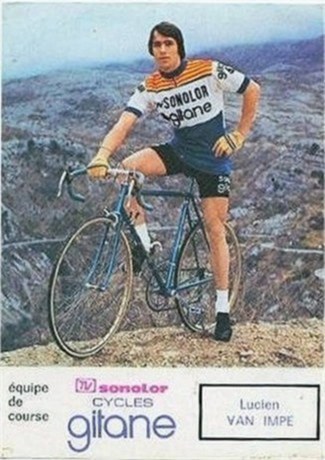

Lucien Van Impe 1974

Lucien Van Imp 1976

Lucien Van Impe breaking away during the 1977 Tour de France

Lucien Van Impe 1980
Lucien Van Impe 1981
Lucien Van Impe wearing the best climber's jersey in the 1983 Tour de France
Click here to learn more about Frederico Bahamontes.

Thursday, December 6, 2012

Victor Fontan

Victor Fontain 
Victor Fontan (1892 - 1982) was a French  professional road racing cyclist. His started racing in 1910 and became a professional racer in 1913. He retired from racing in 1930.

 His career was interrupted by World War I which began in 1914 and lasted until November 11, 1918. Fontan was shot twice in one leg while fighting in the war. He returned to racing when he was demobilized in 1920. 

Victor Fontan first raced the Tour de France in 1924 as an independent but did not finish. He was 36 years old and considered by many to be too old. 

In 1928 he raced the Tour de France for Elvish Bicycle Company, a local manufacturer. The race organizers had set up seven flat stages of the tour that year as team time trials. Fontan's team was lacking in talent and he had to nurse the other team member's along on these stages. During the mountain stages, where he could race alone, he was able to show his true abilities. He won the 7th and 9th stages of the race and came in 7th place overall in the general classification at the end of the race. 

Victor Fontan raced as an independent during the 1929 Tour de France. Without having to look after slower team mates, Fontan was able to race at his on pace.

 During the 7th stage of the 1929 Tour de France he was in a breakaway with 8 other riders. All the riders in the breakaway were awarded the same finishing time for the day of racing. Three riders had the same accumulated time for the stages raced so far. This presented a unique problem for the time keepers. They didn't have anyway of deciding a tie. Victor Fontan, Nicolas Frantx and Andre Leducq were all awarded the yellow jersey of the race leader. This was the only time there were three racers all wearing the yellow jersey during a Tour de France. Having three racers all wearing the yellow jersey only lasted for one day. The next day the yellow jersey was awarded to Gaston Rebry. Now they would look at the fractions of seconds in the time trial stages and declare a single race leader. 

The 9th stage of the Tour de France included the climbs of the mountains the Aubisque and the Tourmalet. Fontan finished this stage in second place and regained the yellow jersey of the leader of the Tour de France. 

The 10th stage of the 1929 Tour de France was 323 kilometers (200.7 miles) and due to it's length began before daylight. Early on in the stage Fontan had an accident and broke the fork on his bicycle. There are several versions as to the cause of the his crash. One account is that a dog ran in front of him and caused him to fall. Another is that he ran off the road and crashed into a ditch. His machine was not ride-able and according to the 1929 race rules he had to show his damaged machine to a judge in order to change bicycles. All the judges had passed by and he didn't have a second bike. He reached a village and went door to door, before dawn, asking to borrow a bicycle. He finally found one and set off to try and catch the race with his damaged machine strapped to his back. He chased for 145 kilometers (90.1 miles) through the Pyrenees mountains before giving up and abandoning the race. He was sobbing and wearing the race leader's yellow jersey at the time of his race abandonment. The next year the race organizer, Desgrange, changed the rules to allow spare bicycles or a rider being able to give a teammate his bicycle.

When racing the 1930 Tour de France Victor Fontan was 42 years old and unable to make a difference in the race. He retired from racing in 1930.

Victor Fontan's racing career would have surely been different if it wasn't for World War I. He had only raced as a professional for one year when the war began. During the war he was shot twice in the same leg. 
Victor Fontan, leading the Tour de France through the mountains
in 1928.
Victor Fontan carrying his broken bicycle at the 1930 Tour de France.