Thursday, January 12, 2012


Tuesday, January 10, 2012
Monday, January 9, 2012
Gustave Garrigou
 | |||||||||||||
| Gustave Garrigou |
Gustave Garrigou (1884 - 1963) was a French professional racing cyclist that is considered to be one of the best of his era. He is most famous for winning the 1911 edition of the Tour de France. A couple of his other major victories are Milan - San Remo in 1911 and Paris - Brussels in 1907. Garrigou was a thin cyclist who was able to climb well in the mountains but had the power to ride hard on flat sections as well. He turned professional in 1907 and that year won the French National Championship, the Tour of Lombardy, Paris-Brussels and finished second in the Tour de France. He won the Tour de France in 1911 while receiving death threats from fans of another French rider, Paul Duboc, who believed Garrigou to be behind an incident in which Duboc collapsed in the Pyrenees and lay in agony for an hour after drinking from a poisoned water bottle .Garrigou had to ride with a disguise on to prevent being attacked by Duboc's supporters. The culprit was eventually caught and was found to be a helper of a rival tam of Duboc's. Gustave Garrigou's career ended with the out break of World War I in 1914.  Gustave Garrigou riding through the Pyrenees during the 1911 Tour de France. |
Sunday, January 8, 2012
Mild Sunday Afternoon Ride
Click on the photos to enlarge them

Poor Ole' Joe checking out my bike


 Before I was injured my plan was to spend some time riding a fixed gear bike this year. Not because I think it is particularly good training for the type of riding that I do, but simply because I enjoy riding one for a change of pace. Since I hadn't been riding for a while I thought it would be best to try things out today by riding a bike that would coast. I used a Sturmey-Archer S2 hub instead of a fixed gear hub today. This hub is a "two speed kick-back" hub. It has two internal gears and to change between them you pedal back just a bit. The low gear is determined by what ever size cogs you have on the bike. The high gear is an increase of 38%. This worked out fine for the type of ride I did today.
 This bike is equipped with a tab to connect a coaster brake. I have ridden this bike with a Sturmey-Archer S2C hub built into the wheel. That is the same type hub only it has a coaster brake. It had been almost forty years since I had spent much time on a bike with a coaster brake. It was kind of cool to be able to brake and change gears without any controls at all on the handlebar. There are some problems that arise when you ride with a coaster brake that you don't have with hand brakes. The problems are:
- Stopping. Your finesse of the brakes is not near as fast or accurate as it is with hand brakes.
- Getting going. You can't pedal backwards to get the pedals in the position you want to get the bike moving. You have to kind of push off.
I hope my next ride I will be able to go ahead and ride fixed. That's something to look forward too. All I have to do is play around with the size of the cog I want to use in the back. This bike has a 50 tooth chainring on the front. It's been several years since I rode a fixed gear bike. I guess part of the fun is figuring out what gearing works best for the terrain. This is one of the things that keeps cycling interesting.

Saturday, January 7, 2012
Tommy Godwin of England set the record for most miles ever ridden in a single year back in 1939

Tommy Godwin was born in 1912 in Stroke on Trent, England. To help support his family he worked as a delivery boy for a grocer and with the job came a heavy bike with a metal basket. The basket was hacked off and the 14 year old Godwin won his first 25-mile (40km) time trial in 65 minutes.
Godwin left his amateur status at the Potteries Cycling Club to join the Rickmansworth Cycling Club as a professional. After more than 200 road and time trial wins, the mileage record beckoned.
At 5 am on January 1st, 1939 Godwin set out to bring the record home. He wasn't alone; two other British riders started that day, Edward Swann and Bernard Bennett. Swan crashed after 939.6 miles, but Bennet fought it out with Godwin for the rest of the year. In sportsmanship their support teams, which included pace-makers, stopped at 50,000 miles to let the riders complete the attempt on personal merit.
Godwin's bike weighed more than 30 pounds. As war came he rode through blackouts, his lights taped to a glow. Silk knickers were substituted for chamois inserts and Godwin maintained his vegetarian diet. After two months Godwin increased his daily average beyond 200 miles a day, and on June 21, 1939 completed 361 miles in 18 hours, his longest ride of the record.
On October 26, 1939 Godwin rode into Trafalgar Square having completed 62,658 miles, gaining the record with two months to spare. He rode through the winter to complete 75,065 miles in the year. In May 1940 after 500 days of riding he secured the 100,000-mile record as well. Godwin dismounted and spent weeks learning how to walk before going to war in the Royal Air Force.
Godwin returned in 1945, keen to race as an amateur. However, despite a petition by fellow cyclists the governing bodies ruled that having ridden as a professional he was barred from amateur status. Godwin became trainer and mentor to the Stone Wheelers. Godwin died at the age of 63, returning from a ride to Tutbury Castle with friends.
The record is still open for challenge but not entry in the Guinness Book of Records whose editors say further attempts would be too dangerous.


This article was written by Dave Barter for CTC www.phased.co.uk
Jules Buysse
Jules Buyss

Jules Buysse (1901 - 1950) was a Belgian racing cyclist.
Buysse was the youngest of three brothers who competed in the Tour de France. He won the first stage of 1926 Tour de France by 13 minutes and 6 seconds, allowing him to wear the yellow jersey for two days until losing it to fellow Belgian Gustave Van Slembrouck. He finished the tour in 9th place.
His brothers were Lucien Buysse who won the 1926 Tour de France, and Marcel Buysse who won six stages on the 1913 Tour.
 |
| Jules Buysse |
Friday, January 6, 2012
Bartolomeo Aimo

Bartolomeo Aimo (1889 - 1970) was an Italian professional road racer. He finished on the podium of the Giro d' Italia four times (1921, 1922, 1923, 1928) and on the podium of the Tour de France two times (1925, 1926) but never won a grand tour.
 |
Bartolomeo Aimo 1925 |
Thursday, January 5, 2012
Marcel Buysse
 |
| Marcel Buysse 1913 |
Marcel Buysse (1889 - 1939) was one of three brothers who were Belgian Road Racers. He and his brothers Jules Buysse and Lucien Buysse all raced the Tour de France. Marcel's brother Lucien Buysse was the winner of the 1926 Tour de France. Two of his sons, Norbet and Albert Buysse, were also racing cyclists.
While competing in the 1912 Tour de France, Marcel Buysse was the led rider for two days until he had the misfortune of breaking a handlebar. He won six stages of the 1913 Tour and finished in 3rd place.
In the 1919 edition of the Giro d'Italia, Marcel, finished in 3rd place in the general classification.

Monday, January 2, 2012
Paul Component Engineering


Riders that remember Campy High Flange Hubs will appreciate the beautiful styling of Paul's High Flange Hubs. These front hubs are available in a bolt on track hub or a quick release road hub. Black or polished finishes are both available.
Add some beauty, style and great performance to your bike with "Nice Parts" from;
Paul's Component Engineering! Made in Chico, California, USA.

A Paul's High Flange Track Front Hub With A Polished Finish.
 Paul's Front Track Hub Laced Into A Wheel.


Complete Wheel Built With A Paul's High Flange Track Hub and A Velocity Pro Elite Tubular Rim.
Click on the photos to enlarge them.
Sunday, January 1, 2012
Saturday, December 31, 2011
Jean Aerts
 |
Jean Aerts Jean Aerts (1907-1992) born in Laken near Brussels, Belgian, was a professional road racing cyclist. Aerts won the 1927 Amateur Road Race Championship and the 1935 Professional Road Race Championship. His greatest ability was that of sprinting. His climbing ability wasn't strong enough to make him a contender in the great tours. Jean Aerts won 11 stages in the Tour de France, 6 of those victories were during the 1933 race. He also finished 9th over all in the 1933 Tour.  Jean Aerts |
Friday, December 30, 2011
Louis Heusghem
 |
| Louis Heusghem
Louis Heusghem (December 26,1882 – August 26,1939) was a Belgian professional road bicycle racer. He was the brother of cyclists Hector Heusghem andPierre-Joseph Heusghem. His best Tour de France finish was his fifth place in 1911. In 1912, he won a stage in the Tour de France and Paris–Tours.
 |

Thursday, December 29, 2011
Federico Bahamontes
 |
| Fedrico Bahamontes Wearing The Yellow Jersey.
Fedrico Bahamontes ,nicknamed the "The Eagle of Toledo", is a former Spanish professional road racing cyclist. He is most famous for his 1959 Tour de France race and winning the "King of the Mountains" classification in that race six times (1954, 1958, 1962, 1963 and 1964). He is considered one of the best climbers ever and was the first Spaniard to win the Tour de France.

Bahamontes started cycling in an effort to scratch out a living after the brutal three years of the Spanish Civil war. He was from a poor family that like millions of others was devastated by the war. This is how he describes becoming a cyclist: "I became a cyclist at the age of 10 because I would have starved otherwise. I used to nab fruit off the lorries in the local market and sell that, and with the money I made I bought my first bike in order to sell more fruit faster. I'd ride around with up to 150 kilos of fruit and vegetables on the back of the bike, but all that extra weight, I think, helped me become a better mountain climber. Once I shed it all, I could fly." He describes his second race and first victory experience at age 17 as:
"I only had a lemon and a banana to eat all day, and I was so hungry I ate the lemon peel and all, but I still won. I'd done 60km that day selling stuff on the black market, but I attacked from the gun and that was that. It was the same as the Tour [in 1959]; they all reckoned I'd crack out there by myself. But nobody could catch me."

Federico quickly realised he could make more money racing his bike than he could selling stolen fruit. He traveled around spain to various races by catching rides on freight trains. He was winning races and making some money. Word of his race winning skill got around Bahamontes was selected to ride the Tour de France for Spain in 1954.
Federico Bahamontes describes his race tactics as simply attacking. "I had only one tactic, and that was attack, attack and attack again," the Eagle admits. "From start to finish."
One of the most famous stories about Bahamontes racing was that he had once attacked on an Alpine mountain pass so that he could have time to stop and eat an ice cream at the top. He tells what really happened as: "One of my wheel spokes broke halfway up, so I attacked so the repairs could be carried out at the top without me losing time," he explains. "But the team car carrying the spares got stuck behind the main bunch, so I bought an ice cream to pass the time. After that I was known as the 'ice-cream rider' - I wish I'd never stopped!"

Federico Bahamontes during the 1954 Tour de France.
He was known as a rider with a terrible temper. Once he was insulted by a spectator during a race, Bahamontes promptly turned around and wielding a bike pump, chased after him for an hour. Another time when the Tour of Spain organizers re-admitted six riders who had pulled out exhausted as they could not handle the pace set by Bahamontes, he got so angry he quit the race himself.

Bahamontes at the top of the Col de Tourmalet during the 1954 Tour de France.
While a fantastic climber Bahamanotes must be described as a cautious descender who often put one foot down to make it around bends in the road. This most likely can be contributed to him once crashing during a descent as an amateur and landing in a cactus bush. Once he waited at the top of Col during the Tour de France for other riders to arrive so he wouldn't have to descend the mountain alone.

Federico Bahamontoes
Bahamontes retired in 1965 to open a bicycle and motorcycle shop in Toledo, Spain. The town where he was born July 9, 1928.

Federico Bahamontes in his bicycle shop.

Federico Bahamontes during the 1956 Tour de France.
In 1950 Federico Bahamontes won the National Amatuer Road Race Championship of Spain. In 1958 he won both Spains National Time Trial Championship and the National Road Race Championship.
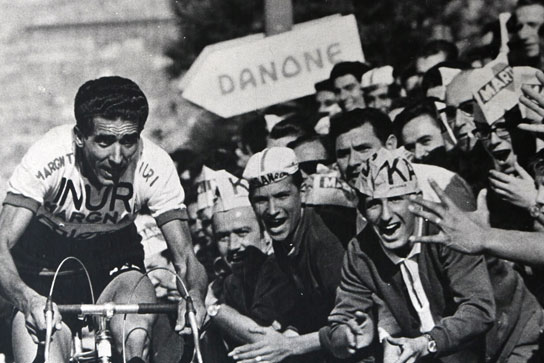
Bahamontes cheered on by fans.
|
Tuesday, December 27, 2011
Monday, December 26, 2011
Sunday, December 25, 2011
Bicycle Advertising Posters

Bicycle advertising posters are artistic fuel for the imagination. Best of all they are promoting bicycles! Hopefully you have noticed that on the right side bar of this blog there is often a cycling advertising poster. These will change almost daily as long as fresh ones can be located. Keep an eye out for them and I hope you enjoy them as much as I do.
At the turn of the nineteenth century, bicycles were all the rage throughout Europe and North America. New bicycle manufactures were springing up everywhere. The invention of multicolor printing was developed along the same time and transformed the advertising industry. Artists were moving to Paris and other major cities to try it out. Suddenly posters were being seen as an art form.
Saturday, December 24, 2011
Tuesday, December 20, 2011
Greg Lemond's Amazing Time Trial To Win The 1989 Tour de France

Greg Lemond and his 1989 Tour de France winning Time Trial Bike
Greg Lemond rode the time trial of his life during the final stage of the 1989 Tour de France. Going into the final stage he trailed the race leader by 50 seconds. Before the final stage began he had already been congratulated for finishing the Tour in second place. No one thought that he would be able to gain enough time in the 24.5 km (15.223 miles) time trial from Versailles to Paris to win.

He pushed a gear of 54 x 12 to a Tour de France time trial record average speed of 54.545 kmh (approximately 34 mph)! Some calculations have suggested he was producing around 513 watts. Lemond's time trial was the fastest of the day and he was 58 seconds faster than Laurent Fignon. This gave Greg Lemond his second win in the Tour de France by the closest margin ever in the race.
The final 1989 Tour de France General Classification:
1. Greg Lemond (ADR-Agrigel): 87 hours, 38 minutes, 35 seconds
2. Laurnet Fignon (Super U) @ 8 seconds
3.Pedro Delgado (Reynolds) @ 3 minutes, 34 seconds
4. Gert-Jan Theunisse (PDM) @ 7 minutes, 30 seconds
5. Marino Legarreta (Patemina) @ 9 minutes, 39 seconds
The final 1989 Tour de France General Classification:
1. Greg Lemond (ADR-Agrigel): 87 hours, 38 minutes, 35 seconds
2. Laurnet Fignon (Super U) @ 8 seconds
3.Pedro Delgado (Reynolds) @ 3 minutes, 34 seconds
4. Gert-Jan Theunisse (PDM) @ 7 minutes, 30 seconds
5. Marino Legarreta (Patemina) @ 9 minutes, 39 seconds
Below is a video of his historic ride.
This video describes the development of early Aero Bars.
Sunday, December 18, 2011
Jean Dotto
 |
| Jean Dotto Jean Dotto (March 27, 1928, - February 20, 2000) was the first French racing cyclist to win in 1956 the Veulta a Espana. He rode the Tour de France 13 times, finishing in fourth place in 1954. Dotto was a good climber. He became an independent, or semi-professional, in 1948. His first year as a independent he won a race up Mont Ventoux and also won Marseille-Toulon-Marseille. In 1950 Dotto won the climb of La Turbie, near Nice. He turned professional in 1951 for France-Sport-Dunlop and won five races, including three hill climbs, in his first season. He rode until 1963, winning 35 races, including the Dauphiné-Libéré twice. He won stage 19 of the 1954 Tour de France and next year won the Vuelta by beating Julio Jiménez of Spain and Raphael Geminiani of France.  |

Saturday, December 17, 2011
DERNY

Derny is the brand name of a French manufacturer, Roger Derny. The Company was founded in 1930 and closed in 1958. He was the inventor of the moped used in Bordeaux-Paris. The Derny is considered a hybrid; half-light motorcycle, half-bike. The speed of a Derny is controlled by pedaling. The faster you pedal, the faster the engine runs. This way the changes in speed are similar to the way a bicycle changes speed. Making it easier for the cyclist to draft behind it. The size is approximately that of a bicycle. The machine is equipped with a fuel tank located between the handlebars and the front wheel. It was first used in Bordeaux-Paris in 1938.


A 1952 Derny
The Derny, pictured above, features a hand-made steel frame and is equipped with a 2-stroke ZURCHER motor. The motor has a displacement of 90cc and produces 2 horsepower @ 2400 rpm. The front gearing is a single 60 tooth chainring. In the rear gearing has cogs of 14-17-21 teeth. A Cyclo 3 speed bicycle rear derailer changes the chain from cog to cog in the back. This Derny is equipped with a rear rack, a rear wheel stand and a pump.

Louison Bobet in Bordeaux-Paris 1959
Thursday, December 15, 2011
Wednesday, December 14, 2011
Paris-Roubaix 1990: The closest finish in this race ever. Decided by less than a centimeter!
 |
| Eddy Planckaert and Steve Bauer sprinting for the finish line of the 1990 Paris-Roubaix.
In 1990 the 88th edition of Paris-Roubaix had the closest finish ever for this race. There were 186 starters and only 92 finishers. The average speed of the race was 34.855 km/h or 21.658 mph. After racing 265 km (165 miles) of the toughest of all the classics, the outcome was decided by two riders tossing their bikes toward the finish line. Eddy Planchaert won by less than a centimeter.
Only 20 km into the race three riders, Stefan Joho, Peter Pieters and Rob Kleinsman, broke away from the main field. Over the next 76 km the three racers built a 16 minute lead as they entered the first section of cobbles at Troisvilles.
A group of 21 riders had been chasing for 100 kilometers and had closed the gap to the three break-a-way rider to only 50 seconds at the beginning of the famed cobbled section in the Arenberg Forest. Kleinsman had a flat tire and was elimanated from the break. The Belgain Eddy Planckaert attacked solo out of the 21 chasing riders. Planckaert quickly caught and passed the two riders remaining in the initial break. Planchaert's lead built to 1 minute and 15 seconds, but there were 65 km left in the race. A strong chase group was working to catch up to Planchaert. Two riders from the chase group, Martial Gayant and Kurt Van Keirsbulck, bridges up to Planchaert and the three built the lead to 2 minutes and 5 seconds.

A chase group formed of 15 riders lead by Laurent Fignon. The Panasonic team did their best to slow the progress of the chase. Fignon, despite Panasonic's efforts, closed the gap down to 20 seconds. He was unable to close the final meters. At this point Steve Bauer, Eddy Van Hooydonck a 2 others rode across to the Planckaert breakaway.
At the next cobbled section, Camphin-en Pevele 25 km from Rouabaix, Bauer attacked hard. Panckaert and Van Hooydonck were the only two that were able to latch on to his wheel.
The peleton was closing in on the three riders as they reached the town of Roubaix. Several riders joined them while they were on their finishing lap on the Velodrome. Bauer started his sprint and Planckaert responded. The two were pretty much even as their sprint drew near to the finish line. Both riders gave one final push as they threw their bikes forward toward the line. Neither rider raised their hands in victory.

The photo finish.
The huge crowd at the velodrome was silent. Finally the finish line judge, Joel Menard, made the announcement: "Eddy Planchaert, the winner by less than a centimeter!"
265.5 km from Cmpiegne to Roubaix (Veledrome), winning time of 7 hours, 37 minutes and 2 seconds.
Below is a video of the last part of the race.
Below is around an hour of coverage of the 1990 Paris-Roubaix from Eurosport Vision with commentary by David Duffield divided into 4 parts.
|
Subscribe to:
Posts (Atom)