Saturday, July 9, 2011

Jean Robic


[Robic.jpg]
Jean Robic.

Frenchman, Jean Robic stood almost 5 feet tall and weigh a scant 132 Ibs. Maybe because it was due to the 'Napoleon complex,' that made this tiny athlete an obnoxious & amp; spiteful personality of the peloton. He wasn't dashing or even good looking. Fellow riders called him, 'Biquet' or kid goat. And after fracturing his skull at the 1944 Paris-Roubaix he started to wear a leather helmet. And with huge ears sticking out, he was called, 'tete de cuir' or leather head. Journalists already endured him, 'le farfadet de la lande Bretonne' - the hobgoblin of the Brittany moor. His 'popularity' was just beginning...

The 1947 Tour was dubbed, 'the Liberation Tour,' as a new France emerged from out of the ashes of the war. Robic was twenty-five, his first Tour, a newlywed, rode for the lesser western regional team, and had the right amount of cockiness to challenge sentimental favorite, Rene Vietto. The tiny Robic rode on a 19 inch frame, turning very long 172 mm cranks while pushing 44X21. He won three stages and was at the top of GC. On the final stage Robic attacked dropping his main rivals including the race leader Pierre Brambilla and won the Tour into the Parc des Princes without having worn the yellow jersey. L'Equipe named Robic, Jean le hargneux - the fierce. Post war France had a new hero.


Leatherhead in the mountains, 1947 Tour.

In the 1953 Tour, Pyrenee stage to Luchon, his climbing was still good but he was too light to gain time on the downhills. With the help from his director sportif, his aluminum water bottles were filled with lead. At every summit, Robic was handed what appeared to be a 'normal' bottle ...only to rocket him down into victory in Luchon. The next day he crashed and withdrew from the race. He rode the Tour again in 1954, '55 and '59 without finishing.

In 1980, Jean Robic tragically died in a car accident on his way home from celebrating the Tour victory of Joop Zotemelk. He was only 59!


Robic mania, 1947 Tour.

Thursday, July 7, 2011

Rudi Altig's Broken Fork


Click on the image to enlarge it

Stage 9, 1962 Tour de France. Green Jersey wearer Rudi Altig was preparing to contest the final sprint when, 12 kilometers from the finish, the right fork blade on his Helyett broke at the crown. Reluctant to stop for a bike change and risk losing contact with the peloton, Altig decided to nurse his damaged bike to the finish. It was a risky decision, but Altig and bike made it to the velodrome in Bordeaux, and finished that year's Tour with the Green Jersey


Bilenky Junkyard Cyclocross 2010 from In The Crosshairs on Vimeo.

Tuesday, July 5, 2011

Roger Lapebie


Roger Lapebie
Click on the images to enlarge them

Roger Lapebie ( January 16, 1911 –  October 12,1996) was a French racing cyclist who won the 1937 Tour de France. In addition, Lapébie won the 1934 and 1937 editions of the Critérium National. He was born at Bayonne, Aquitaine, and died in Pessac.
Roger Lapebie leads Leo Amberg


Lapébie won the 1937 Tour by riding 4,415 kilometers in 138 hours, 58 minutes and 31 seconds. His victory was controversial as he was the first rider to complete the race using a modern derailleur. This gave him the advantage of shifting gears without having to stop, dismount and flip the wheel as was customary of racing bicycles used at the time. Lapébie was also known to accept outside assistance in violation of the rules and was at one point penalized 90 seconds by race commissaires.
The advantages taken by Lapébie angered his Belgian rival, Sylvère Maes who won the Tour the previous year. Maes had led the race through the Alps and Pyrenees but decided to quit in protest of Lapébie's tactics and derailleur use after the 16th stage to Bordeaux. Lapébie, in second place, regrettably took the yellow jersey in the absence of Maes and kept it until Paris. The victory delighted the French but angered the cycling-proud Belgians.
Following Lapébie's victory derailleurs became standard racing equipment in the Tour peloton.
Lapebie in France 1937

River Park Group; Fourth of July Ride


Click on the images to enlarge them
There were at least 3 different groups leaving from The River Park today.

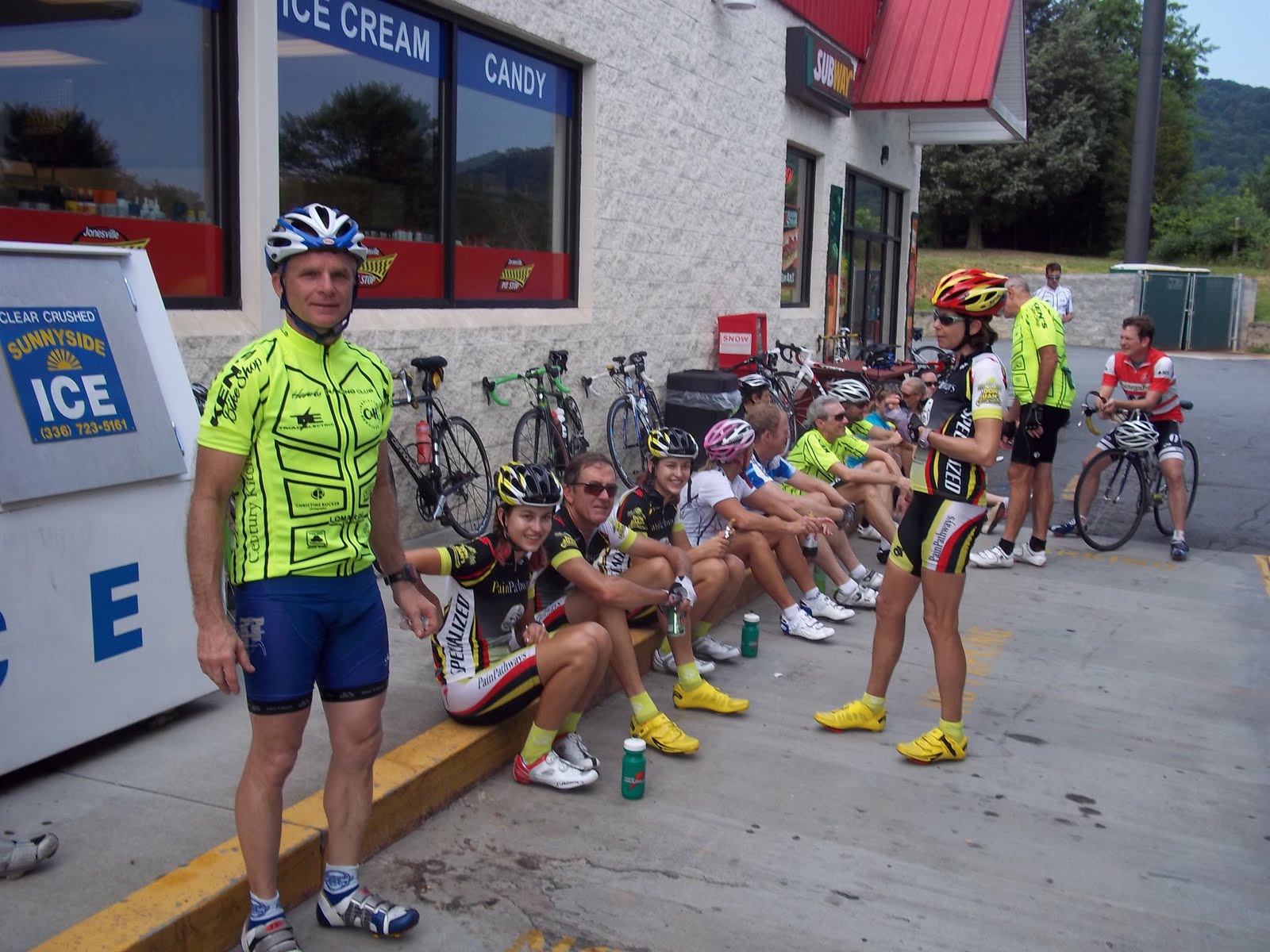
I rode with The River Park Group today. They ride from The River Park on Old Highway 421 at 8:30 on Monday, Wednesday and Fridays. Their typical ride is 40 miles in length and averages 16.5 mph to 18.5 mph. Today's ride was typical of that. I got in a few extra miles since I rode to and from the park. My total mileage was 60.5 miles with an average moving speed of 17.9 miles an hour. This is a good group to ride with if it fits into your schedule. Edmond does an excellent job of leading the rides. 

A rest stop at a store outside of  East Bend, NC.

There were a lot of different groups of riders out today. Here we see a group of  three as we are riding by  Rag Apple  Lassie Vineyards on Rockford Road.

Our group on Rockford Road.

Yet another group on Rockford Road!

Tom's bike has these beautiful Campagnolo Cobalto Brakes. I had to admire them at the rest  stop and take this picture to share them.Cobalto Brakes are a luxury version of Campagnolo's traditional Record side-pull brake with a decorative blue jewel in the brake arm locknut.

Sunday, July 3, 2011

Jacques Anquetil: 1965 Dauphine Libere and Bordeaux-ParisJacques


Anquetil and a Derny

In 1965, Anquetil won the eight-day Alpine Critérium du Dauphiné Libéré stage race at 3pm, sat through two hours of interviews and receptions, took a 6:30pm chartered flight to Bordeaux and won the world's longest single-day classic, Bordeaux–Paris the following day. The race started at night and continued, from soon after dawn, behind derny motorcycle pacers.
Anquetil was upset, said Raphaël Géminiani in his autobiography, that his rival, Raymond Poulidor was always more warmly regarded even though he had never won the Tour de France. In 1965, when Poulidor was perceived to have received more credit for dropping Anquetil the previous year on the Puy-de-Dôme than Anquetil had received for winning the whole Tour, Géminiani persuaded him to ride the Dauphiné Libéré and, next day, the 557 km Bordeaux–Paris. That, he said, would end any argument over who was the greater athlete.
Anquetil won the Dauphiné, despite bad weather which he disliked, at 3pm. After two hours of interviews and receptions he flew from Nimes to Bordeaux. At midnight, he ate his pre-race meal and then went to the start in the city's northern suburbs.
He could eat little during the night because of stomach cramps and was on the verge of retiring. Géminiani swore at Anquetil and called him "a great poof" to offend his pride and keep him riding. Anquetil felt better as morning came and the riders dropped in behind the derny pacing motorcycles that were a feature of the race. He responded to an attack by Tom Simpson, followed by his own team-mate Jean Stablinski. Anquetil and Stablinski attacked Simpson alternately, forcing him to exhaust himself, and Anquetil won at the Parc des Princes. Stablinski finished 57 seconds later just ahead of Simpson.
The historian Dick Yates said:
It had been one of the hardest and closest derny-paced races in history but much more than that this double of Anquetil was one of the greatest exploits ever seen in cycling. At the Parc des Princes, Anquetil received the biggest ovation of his career, certainly much bigger than after any of his wins in the Tour. The race record was broken, Jacques was mobbed by reporters and photographers but he was tired and really had to get some rest. Few people realised it at the time but he had to make the long journey to Maubeuge in north-eastern France where the following day he was riding a criterium!
There are strong and undenied rumours that the jet laid on to get Anquetil to Bordeaux was provided through state funds on the orders of President Charles de Gaulle. Géminiani mentions the belief in his biography, without denying it, saying the truth will come out when French state records are opened to scrutiny.

On the Paris' Parc des Prices Velodrome

Geminiani and Anquetil shake hands across the hood of a 1965 Ford Mustang.

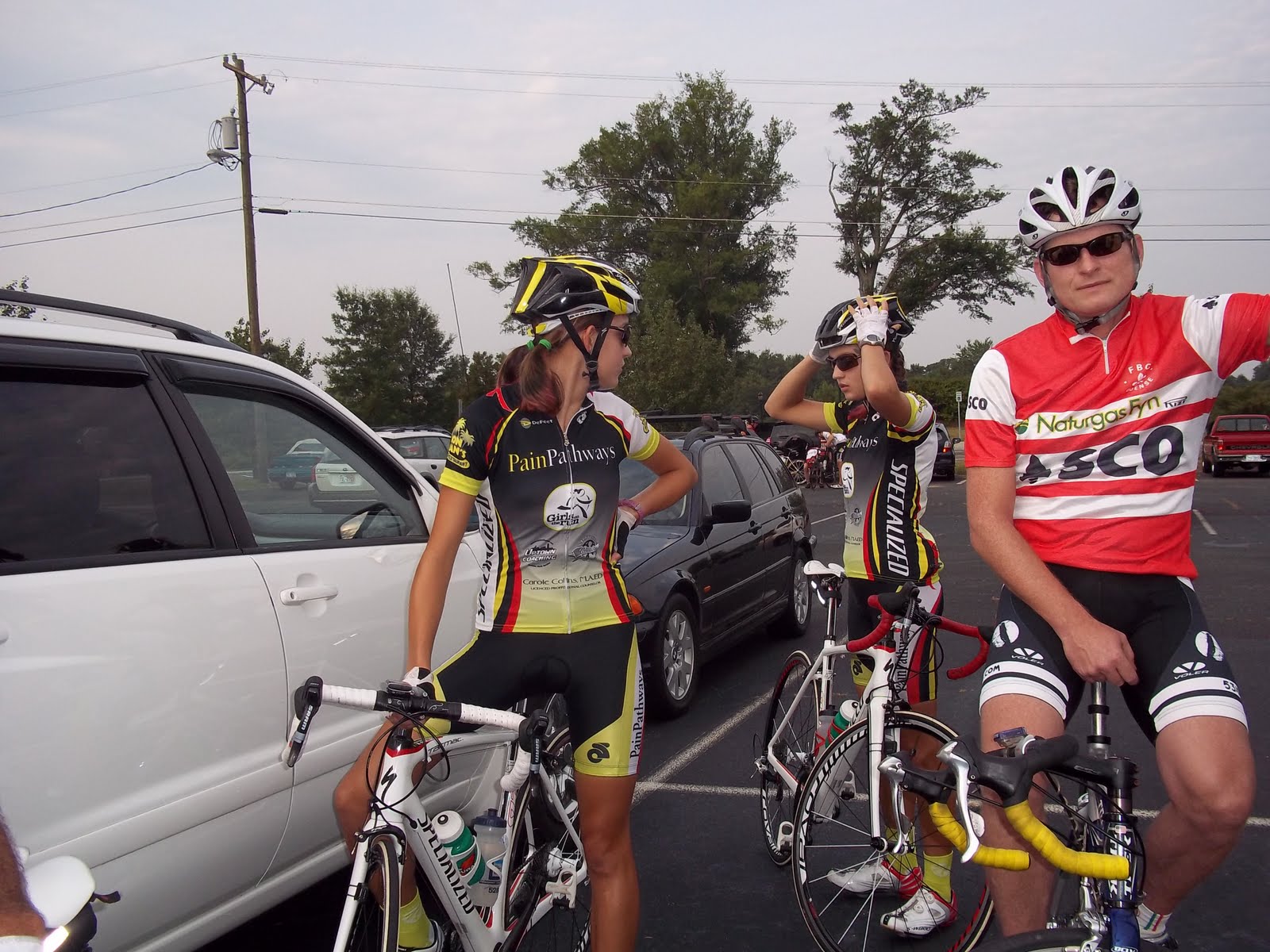
Center Road Group Ride, ride leaders Louis and Alan 7/3/11


Click on the images to enlarge them

Louis Sporting the new high visibility Hearts Jersey
The ride we did today is named Center Road. It began at the Town Square in Lewisville, NC and went through Yadkinville, NC. On the other side of Yadkinville we ended up on Center Road for a good ways. The group averaged close to 19 mph today.  The route is approximately 58 miles, according to the Forsyth Bike web site. Click here to go to Forsyth Bike and find out more about these rides. 
The group gathering before the ride begins

Keri Shields

The Shields Twins and Ben Mosely before the ride. Ben lives in South Carolina now and we only get to ride with him  once or twice a year .
At the rest stop.

David

Torrents on the Galibier


Click on the image to enlarge it
Descending the Galibier during the 1948 Tour de France, Lucien Teisseire rolls through runoff from a flooded mountain stream.

Friday, July 1, 2011

Gastone Nencini


Click on images to enlarge them

Gastone Nencini born March 1, 1930 in Barberino di Mugello, Italy won the 1960 Tour de France and the 1957 Giro d'Italia.


Nicknamed; Leone del Mugello, "The Lion of Mugello",
Nencini was a powerful all-rounder, particularly strong in the mountains.

He was an amateur painter and a chain smoker. He was a gifted descender. "The only reason to follow Nencini downhill would be if you had a death wish", said the French rider Raphael Geminiani. It was trying to follow Nencini down a mountain that Roger Riviere missed a bend, crashed over a wall and broke his spine. 


Tuesday, June 28, 2011

421 River Park Group Ride Monday 6/27/11


Click on the images to enlarge them
421 River Park Group ride ready to roll.
 The 421 River Park Group Ride is every Monday, Wednesday and Friday at 8:30 AM. The ride, like today's ride, is usually approximately 40 miles in length. The average pace is 16.5 mph to 17.5 mph. A great group to ride with! Today's ride went through the Town of East Bend, NC and then made a loop in Yadkin County. We came through East Bend a second time on the way back to the park. Fun Ride Today!
Michael, Matt, Amanda and Amy.

Tom and his beautiful Tommasini Bicycle. This bike is detail oriented with panagraphed chainrings on the Campagnolo crankset and Campagnolo cobalto brakes. Gina is in the background ready to ride.


Old U.S. 421 River Park

Old U.S. 421 River Park is one of several access points along the Yadkin River Trail. The primary purpose of the site is for public access to the Yadkin River for canoeing, fishing, and family picnicing. The site offers an excellent opportunity to enjoy the vista of the Yadkin and the sports and pleasures of our County's only river. For more information on the 421 Park click here.


I rode to the ride from home, so I got in a few extra miles.


Monday, June 27, 2011

Firmin Lambot


Firmin Lambot (March 14, 1886 - January 19, 1964) was a Belgian bicycle racer who twice won the Tour de France.

Born in the small town of Florennes, Lambot worked as a saddle maker. He worked 12 hours a day, starting at 6am. He bought his first bicycle at 17 and began riding 50km a day to and from work. His first race was in a local village; he won five francs as first prize. He then bought a racing bike. 

He began racing professionally in 1908. In that year he won the championships of Flanders and Belgium.  He rode the Tour de France from 1911 to 1913 but World War I ended the race for the next five years.

When the Tour returned in 1919 it was a miserable affair of war-torn roads, fractured logistics and former contenders no longer alive to compete. Only 11 riders finished. Lambot was approached at the Buffalo track in Paris, where he had ridden a 24-hour race, to ride the Tour on the Globe Cycles team. He was second for much of the race but took the lead when Eugene Christophe broke a fork. Observers felt Lambot owed his victory more to Christophe's bad luck than his own ability and a collection for Christophe surpassed the prize money Lambot received. His performance brought him a contract from the larger Peugeot team at 300 francs a month. He was engaged to ride just the Tour de France.


In the 1920 and 1921 Tours Lambot placed respectably and in 1922 he won for the second time after Hector Heusghem was handed an hour penalty for swapping his bicycle after breaking the frame. He became the first to win the Tour without winning a stage. Lambot was 36 when he won the 1922 Tour de France . By the end of his career he was paid 1,800 francs a month by his team. In retirement, he returned to work as a saddle maker.

Stuckeyville Group Ride Lead by Louis and Alan


Click on the images to enlarge them

The beginning of the ride in Lewisville, NC
We had a great group today riding the route described on the Forsyth Bike web site as Stuckeyville. The name of the ride comes from the first rest stop being at a Stuckey's Store. Louis and Alan did a great job, as always, of leading the ride.  Click here to go to the Forsyth Bike web site.
The second rest stop at a store in Davie County


In the video below Robert Jordan, wearing a red jersey and riding a bike with a rear rack, is riding fixed. On one long downhill you will notice he is spinning his pedals very fast.

Sunday, June 26, 2011

1936 Tour de France


Tour de France July 16, 1936. As if climbing the Galibier wasn't enough, here's what riders faced descending the other side! That's Germany's Erich Haendel with the cockeyed goggles.

Saturday, June 25, 2011

Leon Scieur


Leoun Scieur
Leon Scieur (March 19, 1888 -  October 7, 1969) was a Belgian cyclist who won the 1921 Tour de France, along with stages 3 and 10. His first great victory was the 1920 Liege-Bastogne-Liege. 


Leon Scieur was the son of a farmer in Florennes, Belgium. He began work as a glassmaker before being introduced to cycling by his neighbor, Firmin Lambot, who taught him to ride a bike at the age of 22.


Scieur turned professional in 1913 and rode his first Tour de France that year, without finishing. He finished 14th in 1914.


After working as a mechanic in World War I Scieur rode the revived Tour de France in 1919 placing fourth. He had punctured four or six times, according to reports, between Le Havre and Cherbourg. The weather was foul and he had no more spares so he had to huddle in a doorway to repair one of the punctures. Mending a race tire involved taking it from the rim, cutting the stitching that held the base together, mending the inner tube, then sewing up the tire before replacing it. Scieur had acquired a needle and thick thread from the woman in whose doorway he was sheltering in, but his fingers grew too cold to use them. He asked the woman to help but the chief official, Lucien Cazalis, told him "It's forbidden to receive help; you'll be penalised if madame threads the needle for you." Scieur completed the repair but lost the Tour to Lambot by about the time it had taken. 


 He finished forth in the 1920 Tour de France.


He won at his fifth attempt, in 1921, when he was 33. He went into the lead on the second day and rode so hard to defend his position that reporters nicknamed him "The Locomotive." He pedaled fast in a low gear, winning two stages, from Cherbourg to Brest and from Nice to Grenoble.


Another Belgian, Hector Heusghem, attacked when Scieur punctured on the Col d' Allos, which climbs to 2,240 meters. Scieur ws so angry at the breach of etiquette that riders weren't attacked when they had mechanical trouble that he set off after Heusghem, lectured him on politeness and tradition, raced off angrily alone and won the stage to Grenoble. The feud that developed between them brought still more reporters from Belgium - this was the first year that foreign reporters could follow the race by car - and made life hard work for everyone. The organiser, Henri Desgrange, wrote a column in L'Auto criticising riders for being too scared of Scieur to challenge him.


Desgrange wasn't slow to criticise or disciple riders who he thought weren't riding hard enough. The 12th stage was 371 km from Geneva to Strasbourg. Scieur was leading the race with Heusghem and a French rider, Honore Barthelemy. Two Belgians, Firmin Lambot and Louis Mottiat, stayed in the main group rather than chase and spoil Scieur's chances. All five riders were in the same team and were using tactics that today would be considered normal. Desgrange, however, believed riders should compete as individuals and not in teams and he banished Lambot and Mottiat to last place.


The Tour became duller after Heusghem and Scieur settled into a sullen truce, but it wasn't without incident. Scieur broke 11 spokes on the next to last stage, from Metz to Dunkirk and again fell foul of Desgrange's rules. He managed to get a replacement wheel but new rules for that year's Tour said he didn't have the right to use it unless he could show Desgranges's judges that the original was beyond use. No judge saw the incident and so Scieur carried the broken wheel on his back for 300 km to the finish. He said it left a mark on his back for 15 years.


Scieur abandonded the 1922 Tour with a broken fork.


Scieur stopped racing in 1924. He spent the rest of his life in Florennes, where he owned a garage and distribution businesses for coal and gas. He died in 1969.

Wednesday, June 22, 2011

Cycle Race - The Milk Race 1982


The Milk Marketing Board (MMB) was a sales monopoly for dairy farmers in England and Wales. A semi-professional cyclist from Derby, Dave Orford, asked the MMB to pay for "Drink more milk" to be embroidered on the jersey of every semi-professional, or independent, rider in the country. 

Orford met the MMB's publicist officer, Reg Pugh, at the board's headquarters in Thames Distton, west of London. Orford said: "At the end of the discussion he stated that the MMB would prefer to sponsor a major international marathon. So the Milk Race, the Tour of Britain, was born, starting in 1958 and lasting for 35 years, the longest cycle sponsorship in the UK ever."

The first two races were open to semi-professionals but from 1960 until 1984 it was open only to amateurs. From 1985 until 1993 the Milk Race was open to both amateurs and professionals. After 1993 the Milk Race ended as the MMB was wound up because of European monopoly laws.

Derby de Saint-Germain


Click on the image to enlarge it
Drafting behind his "entrainer", Charles Pélissier rides towards victory in the rainy 1938 edition of the Derby de Saint Gérmain. 285 kms covered in 6 hrs 25 mins 3 secs behind these lightly-powered cyclomoteurs, here ridden by the ancient stayer racer René Maronnier.